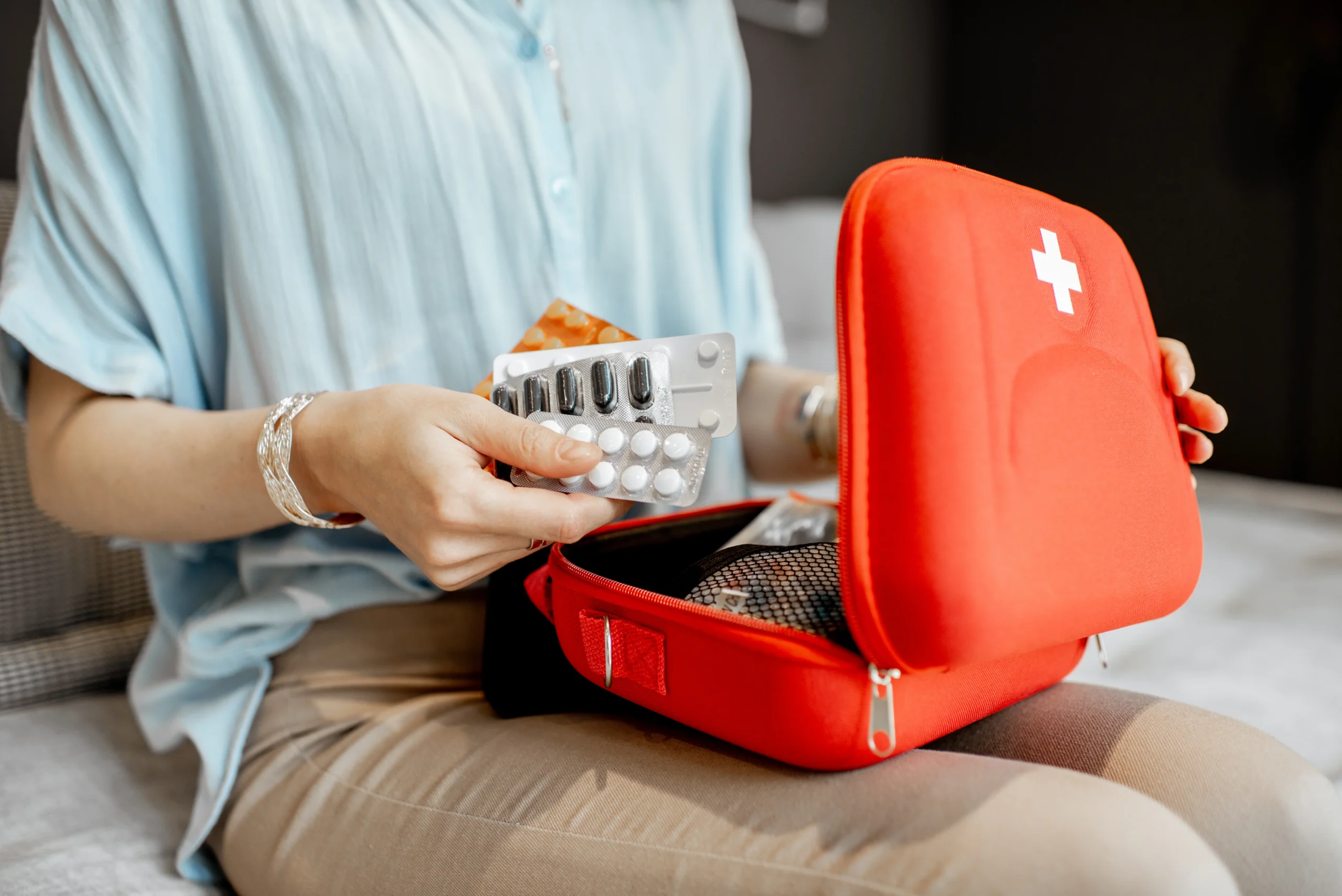

For an older adult taking several prescriptions, a heat wave creates two separate medication questions: are the medicines being stored within their labeled conditions, and are the person’s usual fluid instructions still appropriate for hot weather? Caregivers can prepare for both without changing treatment on their own.
Older adults are more vulnerable to heat-related illness because the body may adjust less efficiently to sudden temperature changes, chronic conditions can affect heat regulation, and some commonly used medicines can influence sweating, thirst, blood pressure, hydration, or alertness. California public-health guidance therefore treats medication use as one part of heat planning for older adults.
For caregivers, the practical work is not to guess which prescription should change. It is to confirm two sets of instructions before a very hot day: how each medicine should be stored and what the person’s clinician has said about fluids, especially when a fluid restriction, diuretic, heart condition, kidney condition, or electrolyte concern is already part of the care plan.
Quick Answer
During a California heat wave, keep medicines according to the product label or manufacturer directions, avoid leaving them in places that can become excessively hot, and have a plan for refrigerated products if power is unreliable. For hydration, do not replace a patient’s existing fluid restriction or clinician instructions with a generic “drink more” rule. CDPH advises people on fluid-restricted diets or diuretics to consult their doctor about hot-weather fluid intake. Do not stop, reduce, double, move, or reschedule a prescription because of heat unless the appropriate clinician gives patient-specific instructions.
Why Heat Creates Two Different Medication Checks
Heat can affect the person taking the medicine and the medicine itself. Those are different problems, and combining them can lead to unsafe shortcuts.
- Person-level risk
- Older adults may have less effective temperature regulation, reduced thirst, chronic illness, or medicine-related effects that increase heat risk.
- Product-level risk
- Some medicines have labeled temperature, light, humidity, or refrigeration requirements that can be breached in hot homes, vehicles, mailboxes, or outages.
- Instruction-level risk
- Advice to drink more can conflict with a prescribed fluid restriction or another clinical plan, so hydration instructions must remain patient-specific.
CDPH’s guidance for local health jurisdictions notes that commonly used medicines among older adults—including some diuretics, beta blockers, antidepressants, antipsychotics, and anticholinergic medicines—can contribute to dehydration, electrolyte imbalance, changes in sweating, reduced thirst, or other effects that may increase heat-related risk. That list is not a reason to stop any of those medicines. It is a reason to make sure the clinician knows about the full medication list when discussing a heat plan.
Heat Risk Does Not Equal a Medication Change
A medication can be associated with heat sensitivity and still be necessary. Any change in dose, timing, frequency, route, fluid restriction, or treatment plan should be made by the clinician who can weigh the person’s condition and medication history.
Start With the Storage Directions on Each Medication
Medication storage should be checked product by product. CDPH’s medication-storage guidance emphasizes following manufacturer requirements because some products tolerate only a narrow temperature range. For refrigerated medicines in regulated facilities, CDPH identifies an expected range of 36°F to 46°F, but that facility standard should not be turned into a universal home rule for every medicine.
At home, use the prescription label, package insert, manufacturer instructions, or pharmacist guidance for the specific product. The phrase “room temperature” does not mean that a medicine can remain indefinitely in a parked vehicle, on a sunny windowsill, inside a hot mailbox, or next to a heat source.
1
Read the exact storage statement
Check whether the label calls for room-temperature storage, refrigeration, protection from light, moisture control, or another condition.
2
Move medicines away from predictable hot spots
- Do not use a parked car, direct sun, an outdoor delivery box, or another high-heat location as routine storage unless the product instructions specifically support it.
3
Plan for refrigerated products before an outage
- Know which medicines require refrigeration and whom to call if the refrigerator loses power or a temperature excursion occurs.
4
Do not guess after a temperature excursion
- Record what happened, including approximate time and temperature if known, and ask the pharmacy, manufacturer, or prescriber for product-specific guidance.
Avoid One-Size-Fits-All Rescue Methods
Do not automatically freeze, ice, discard, or continue using a temperature-exposed medicine based only on a general internet rule. Different products have different stability instructions.
Hydration Instructions Need Their Own Review
CDPH advises older adults to stay hydrated during hot weather, but it also gives an important qualifier: people who have been prescribed a fluid-restricted diet or who take diuretics should consult their doctor about how much to drink in hot weather. This prevents a general heat-safety message from overriding a patient-specific plan.
That distinction matters for caregivers managing several instructions at once. A person may have been told to limit fluid, monitor swelling, follow a low-salt plan, or take a diuretic at a specific time. Another person may have no fluid restriction and may simply need regular access to fluids. The correct approach is to know which plan applies before the heat becomes severe.
- If there is a fluid restriction
- Keep the written clinician instruction available and ask how hot-weather intake should be handled rather than changing the limit independently.
- If a diuretic is prescribed
- Do not skip or reduce it because of heat. Ask the clinician how hydration and the prescription should be managed for that patient.
- If instructions are unclear
- Write down the question before a heat advisory and contact the prescribing office so the caregiver is not improvising during a stressful day.
Use the Medication List to Ask Better Heat Questions
A current medication record gives the clinician and pharmacist the information needed to answer heat-related questions without relying on memory. Include prescription medicines, over-the-counter products, supplements, allergies, strengths, directions, and the prescriber’s name when available.
For an older adult taking several medicines, ask about the list as a whole. CDPH notes that different medicines can affect heat tolerance through different mechanisms. A complete list helps the clinician consider combined risks such as dehydration, low blood pressure, electrolyte changes, sedation, or reduced sweating without treating a single medication name as the entire explanation.
- Which medicines on this list have heat-related precautions we should know about?
- Does this person have a fluid restriction or another hydration instruction that should be followed on hot days?
- Which medicines require special storage, refrigeration, or protection from excessive heat?
- What should we do if the home loses power and a refrigerated medicine warms above its labeled range?
- Which symptoms should prompt a call to the clinician, and which require emergency care?
- Who should the caregiver contact after hours if the heat plan or medication instructions become unclear?
A Caregiver Heat-Day Check That Does Not Change Treatment
A useful heat-day routine can stay focused on observation, access, and instructions rather than medication changes.
Check the cooling plan
Confirm that the older adult has access to a cooler environment and that someone is checking in if the person lives alone or has mobility or cognitive limitations.
Check the hydration instruction
Follow the person’s existing clinician guidance. If there is a fluid restriction, diuretic, heart condition, kidney condition, or another concern, use the patient-specific plan rather than a generic target.
Check medication storage
Keep medicines away from excessive heat and verify that refrigerated products remain within the product’s required conditions.
Check refill and contact information
Confirm that essential prescriptions are available and that pharmacy, prescriber, emergency, and after-hours contact numbers are easy to find.
Check for meaningful changes
Unusual confusion, fainting, severe weakness, worsening breathing, inability to keep fluids down, or other serious changes deserve prompt medical attention rather than a medication adjustment made at home.
When to Call the Pharmacy, the Clinician, or Emergency Services
Call the pharmacy for questions about prescription labels, refill status, medication records, storage requirements, or what information is available about a specific product after a temperature excursion.
Call the clinician when the question involves a fluid restriction, diuretic plan, dose, frequency, timing, blood-pressure medicine, kidney or heart condition, heat-related symptoms, or any other patient-specific treatment decision.
Seek urgent or emergency care for severe heat-related symptoms such as loss of consciousness, new severe confusion, seizures, severe breathing difficulty, or another medical emergency. Do not wait for a routine pharmacy response when immediate care is needed.
Do Not Stretch or Skip Prescriptions to “Reduce Heat Risk”
Heat concerns should trigger a review of the plan, not unsupervised dose changes. Do not ration, skip, double, move, or substitute a prescription because of hot weather unless the appropriate clinician has provided instructions for that patient.
Frequently Asked Questions
Do older adults have a higher risk of heat-related illness?
Yes. CDPH and CDC both identify adults age 65 and older as a higher-risk group because age-related changes, chronic conditions, and some prescription medicines can affect the body’s response to heat.
Should an older adult drink more water during a heat wave if they take a diuretic?
Do not replace the person’s existing plan with a generic fluid target. CDPH advises people who take diuretics or have a prescribed fluid-restricted diet to consult their doctor about hot-weather fluid intake.
Can I stop a medicine that may increase heat sensitivity?
No medication should be stopped or changed solely because it appears on a heat-risk list. The prescriber should decide whether any patient-specific change is appropriate after considering the reason for treatment and the person’s full health history.
What should I do if a prescription was left in a hot car?
Move it out of the heat, keep the package and label, note approximately how long and how hot the exposure may have been, and contact the pharmacy or manufacturer for product-specific guidance. Do not assume every medicine has the same heat tolerance.
Does every refrigerated medication use the same 36°F to 46°F rule at home?
No. CDPH identifies 36°F to 46°F as the expected range for refrigerated medicines in specified regulated facility settings, but home use should follow the specific product’s label or manufacturer instructions.
What can Las Palmas Pharmacy help with during a heat wave?
The pharmacy can help with medication lists, prescription labels, refill status, storage directions, and product-specific medication questions. Fluid restrictions, dose changes, heat-related symptoms, and other patient-specific treatment decisions belong with the appropriate clinician.
Keep Storage Instructions and Hydration Instructions Side by Side
Before the next very hot day, caregivers can make two short checks: confirm how each medicine should be stored and confirm what the older adult’s clinician has said about fluids. That preparation reduces the chance of improvising with a prescription or hydration plan when temperatures are already high.